
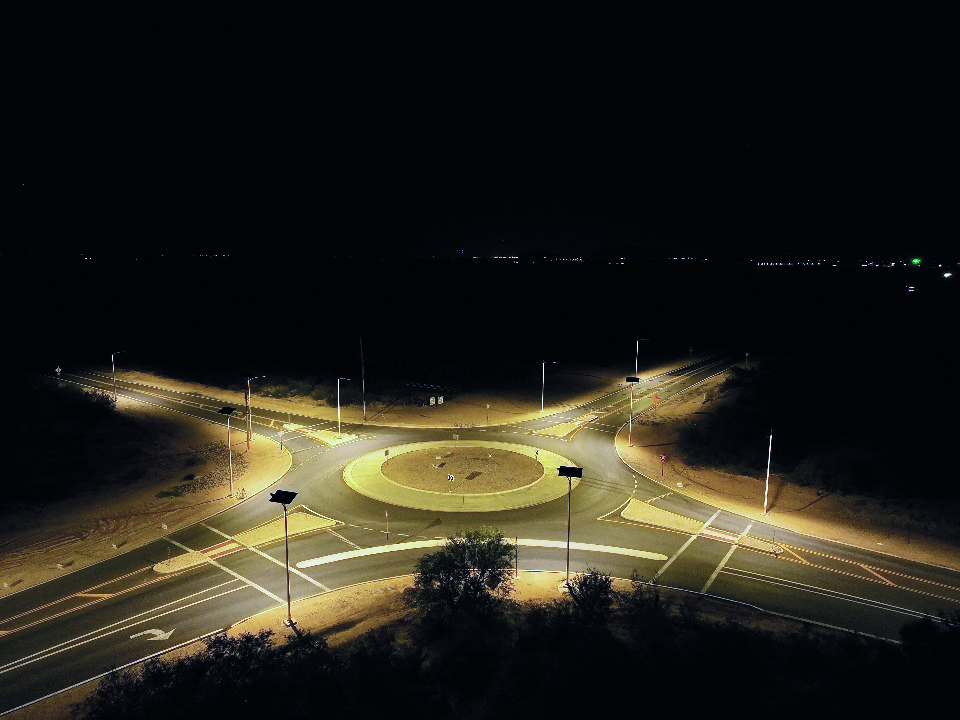
Roundabout Lighting Design for Safer Streets After Dark
Roundabout lighting design helps drivers recognize the intersection, follow its curves and see people crossing the road after dark. For a city evaluating a new roundabout or improving an existing one, those visibility tasks deserve attention alongside lane layout, signs and pavement markings.
Modern roundabouts have a strong safety record. Their geometry slows traffic and reduces the opportunity for severe collisions. Lighting supports that design by helping people see where to travel and when to yield.
The practical questions are straightforward: Can drivers recognize the roundabout early? Are pedestrians visible at every crossing? Does the lighting create glare or leave gaps? And how will the system perform when utility power is interrupted?
Answering those questions gives municipal leaders and engineers a useful starting point for improving nighttime visibility and evaluating solar lighting.
Why roundabouts need careful lighting design
Approaching a roundabout involves several decisions in a short distance. A driver must recognize the intersection, slow down, select the correct lane where applicable, look for pedestrians and yield to circulating vehicles.
Headlights help, but they do not illuminate every place the driver needs to look. Pennsylvania DOT’s design guidance explains that a circulating driver may need to look farther left than the headlights cover. It identifies two lighting purposes: making the roundabout recognizable from a distance and improving visibility where road users’ paths meet. PennDOT Design Manual Part 2, Section 5.9
That is why a lighting review should follow the driver’s route through the intersection. It should also consider the person waiting to cross, the cyclist approaching an entry and the pedestrian using a refuge island between crossing stages.
Engineers call the places where travel paths meet conflict areas. For a city manager, the practical concern is whether people can see one another early enough to respond.
What the research says about nighttime safety
Two types of research help explain the value of lighting: studies of intersections generally and studies specifically examining roundabouts. They answer related questions, but their results need to stay attached to the settings studied.
Intersection lighting has documented safety benefits
FHWA identifies lighting as a Proven Safety Countermeasure. Its lighting fact sheet reports potential reductions of up to 42% in nighttime pedestrian injury crashes at intersections and 33%–38% in nighttime crashes at rural and urban intersections. These are broader intersection findings, rather than measured results for solar lighting at roundabouts. FHWA Proven Safety Countermeasures, Lighting
For municipal leaders, the findings establish a sound reason to include visibility in an intersection safety review. They do not predict the outcome of an individual installation. We made a post about rural intersections regarding light safety before.
Roundabout research provides more specific context
A Georgia DOT research report, revised in 2016, analyzed Minnesota roundabout crash data from 2003–2010. It found observed nighttime crash rates at lit roundabouts were approximately 59%–65% lower than at unlit roundabouts, depending on how the data were weighted.
The authors identified important limitations, including a small sample and possible design or operational differences between lit and unlit sites. The finding is an association, rather than a guaranteed reduction a city can expect from adding lighting. Safety and Illumination of Roundabouts, Phase I, Appendix B, pages B8–B10
A follow-up Georgia study published in 2021 examined 80 rural and suburban roundabouts. It found no statistically significant additional nighttime crash reduction associated with illumination above 5 lux in the studied settings. Urban roundabouts with significant pedestrian activity were excluded. That result does not establish a universal design target or replace an agency’s lighting criteria. Safety and Illumination of Rural and Suburban Roundabouts, Phase II
Taken together, the research supports evaluating lighting as part of roundabout safety while matching the design to the site. Increasing brightness alone is an incomplete strategy. See how Florida used lighting to improve roundabout safety.
What good roundabout lighting should accomplish
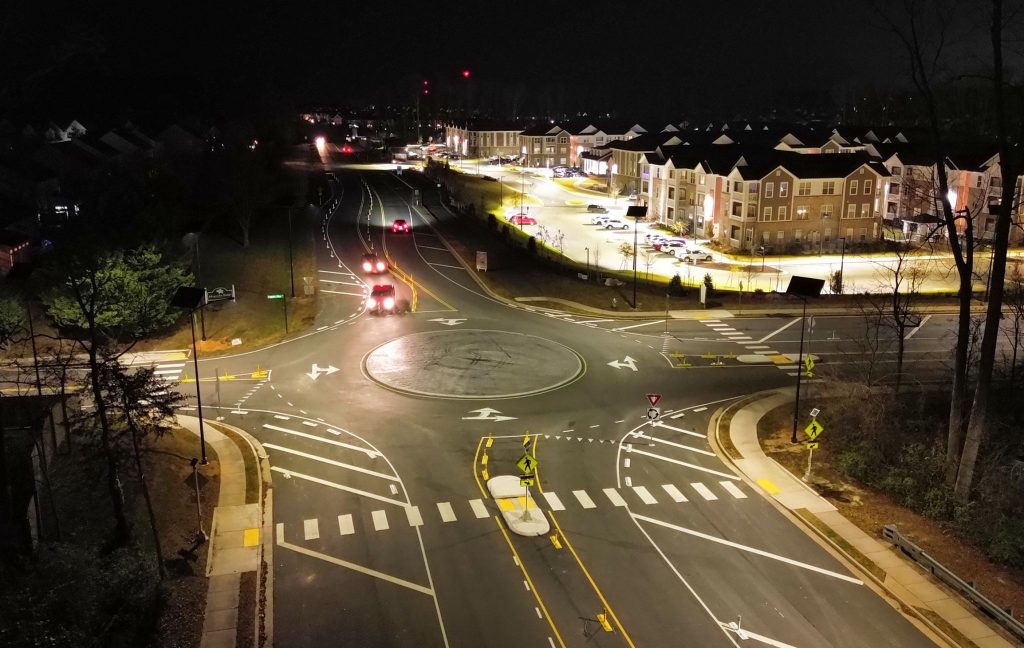
A useful lighting plan explains how the proposed fixtures help people navigate the intersection. It should make the important features visible while controlling glare, uneven coverage and light spilling onto neighboring properties.
Make people visible at crosswalks
Lighting the pavement is only part of the task. Drivers also need to see the person standing beside it or walking across it.
Horizontal illuminance measures light falling on a horizontal surface, such as the roadway. Vertical illuminance measures light falling on an upright surface, such as a pedestrian. Both help describe a lighting design, but they tell different parts of the story. FHWA recognizes both measurements in its discussion of adequate roadway lighting. FHWA lighting guidance
Consider someone waiting beside a brightly lit crosswalk. The stripes may be easy to see while the person remains difficult to distinguish. A review that checks only pavement brightness can miss that problem.
Colorado DOT’s 2024 guidance recommends placing roundabout lights on the approach side of entries to direct vertical light onto entering vehicles and crosswalks. It also advises against locating light standards in the center of the roundabout. Those are useful examples of how pole location supports visibility. CDOT Lighting Design Guidelines, Section 2.2.6
Check coverage across the intersection
A single average light level can hide differences between brighter and darker areas. Uniformity describes that variation. A photometric plan, a calculated map of light levels, lets the project team examine the distribution across the roadway and crossings.
Ask the designer to explain the minimum values and the places where coverage changes. Review the approaches, the circulating roadway, crosswalks and pedestrian waiting areas rather than accepting one headline number for the entire intersection.
Control glare and light spill
As a driver moves around the circle, the viewing angle toward each fixture changes. Lighting design therefore needs to consider visual comfort and the ability to distinguish people and hazards.
Fixture selection, aiming and placement should also account for nearby homes and properties. The Illuminating Engineering Society’s roadway lighting practice addresses visual quality, glare, contrast, maintenance and environmental effects alongside light levels and uniformity. IES RP-8 publication description
Include the approaches
The visibility task starts before the yield line. On an otherwise dark road, drivers need enough information to recognize the roundabout and prepare for its layout.
The extent of approach lighting belongs in the site design. For example, Colorado DOT recommends considering a minimum of 400 feet in front of a roundabout. That is agency guidance for its context, rather than a nationwide distance to apply automatically. CDOT Lighting Design Guidelines, Section 2.2.6
Which roundabout lighting standards apply
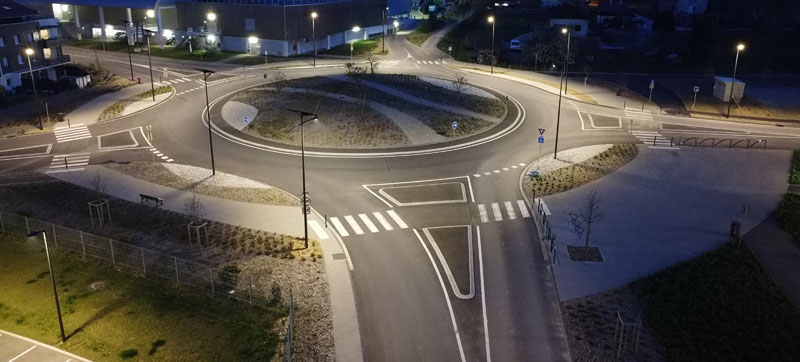
Two references belong in a current design discussion:
- NCHRP Research Report 1043, Guide for Roundabouts, published in 2023, provides national roundabout guidance. It supersedes Report 672, which appears in many older resources. TRB project record
- ANSI/IES RP-8, the recommended practice for roadway and parking facility lighting, includes intersections, roundabouts and crosswalks. The IES currently lists RP-8-25+E2. IES publication listing
The project team should establish which editions and requirements the responsible agency has adopted. A newer publication does not automatically change a municipality’s specifications. IES describes RP-8 as a consensus practice with legislative authority only when adopted by the authority having jurisdiction. IES publication description
For the city, the useful deliverable is a lighting plan that names the applicable criteria and shows how the proposed system meets them.
Where solar lighting can help
Once a city knows what lighting it needs, it can look at how to power the lights. Solar lighting is a great choice when extending utility service or adding underground wires would make the project too hard.
Fonroche Lighting America builds autonomous solar roadway lighting for streets, intersections, and other roadways. Each light pole makes and stores its own power, so the system runs without needing the utility grid. Fonroche solar roadway lighting
Use less utility power
A power outage on the grid will not turn off a standalone solar streetlight. This is why many cities look at solar when planning for infrastructure resilience.
Still, the lighting setup must fit your local weather and site. Ask how the design handles:
- Winter sunlight and shady spots
- Battery capacity and total operating hours
- Long stretches of cloudy weather with poor solar charging
Expected lighting output during bad weather, including any dimmed settings overnight
Because each pole has its own power, damage to one light will not shut off the others. However, a broken light can still leave a dark spot. Your outage response plan should cover both fixing the equipment and keeping the intersection safe and visible.
Cut down on digging and trenching
Solar streetlights do not need underground wires connecting one pole to the next. This helps a lot when a city adds lights around existing pavement or in spots where utility access is tough. Less trenching and cabling is one of the main benefits of Fonroche’s roadway systems. Fonroche roadway lighting applications
Even without trenching for wires, your project scope still needs to include foundations, installation access, utility locating, and traffic control. Compare full installed quotes, including upkeep and future part swaps, so your city can see the true value of each choice.
Questions to ask about your city’s roundabouts
Review nighttime crashes, public concerns, pedestrian activity and nearby destinations.
Follow each approach through the entry, circulating roadway and exit, including every pedestrian crossing.
Ask for a photometric layout showing the applicable criteria, coverage, uniformity and pedestrian visibility.
Compare utility access and solar suitability against the required lighting performance.
Identify inspection duties, replacement access, spare parts and the response to a failed light.
For an initial review, bring engineering, public works and maintenance staff together around the same questions:
This review gives a city a clearer project scope before requesting equipment prices. It also helps distinguish a proposal that fits the intersection from one based mainly on fixture wattage or pole count.
Explore solar lighting for your roundabout
If your city is planning a roundabout or reassessing an existing intersection, start with the places people need to see after dark. Then consider whether solar lighting can deliver that coverage while reducing dependence on utility infrastructure.
Fonroche Lighting America offers application design support that includes a solar energy evaluation and lighting analysis. Learn about the design process.
Request a roundabout lighting quote and share your location, site plan or aerial image, crossing locations and project goals. If you are still exploring options, view Fonroche’s solar streetlights or review product datasheets.