

Where Does Off-Grid Solar Lighting Fit in California?
California’s infrastructure needs vary widely, from busy municipal streets and public spaces to rural roads, Tribal communities, parks, and remote facilities. Because these environments are so different, the right lighting approach depends heavily on the conditions of the individual site.
Access to electrical infrastructure, terrain, existing pavement or landscaping, utility extensions, and the intended use of the space can all influence how a lighting project is planned. Off-grid solar lighting in California becomes particularly relevant when providing conventional electrical service would add complexity to the project. Rather than starting with technology, project teams should first consider where lighting is needed, who will use the space, and what the application needs to accomplish.
Roads and Intersections Without Easy Access to Power
Roadway lighting becomes more challenging when illumination is needed beyond the reach of existing electrical infrastructure. Across California, this can include local roads, intersections, rural corridors, road extensions, and isolated locations where bringing power to individual lighting points would require additional underground electrical work.
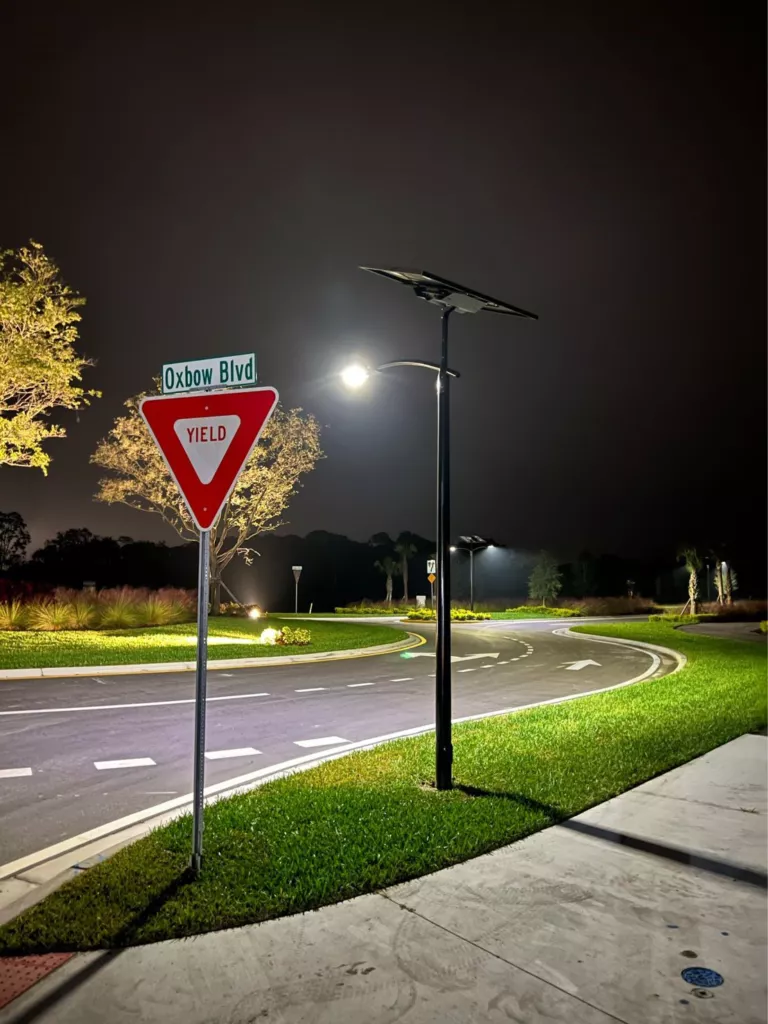
Solar roadway lighting in California provides another approach for these locations. Autonomous systems generate and store energy at each lighting point, allowing roadway lighting to be planned without extending electrical distribution along the entire corridor. This can be particularly useful for targeted locations such as intersections, roadway entrances, or sections of rural roads where lighting is needed, but nearby electrical service is limited. System design should still reflect the roadway geometry, required illumination, traffic conditions, and site-specific conditions.
Parking Lots and Public Facilities
Parking areas often need lighting in locations that were not originally designed with convenient access to electrical service. This can affect municipal parking lots, recreation centers, transit and public facilities, schools, and commercial properties where lighting is needed around parking spaces, entrances, and pedestrian routes.
Solar parking lot lighting in California gives project teams another way to plan illumination without automatically extending underground electrical distribution throughout the site. Because each system can generate and store energy at the lighting location, placement can be evaluated around the areas that actually need illumination. For municipalities and property owners, this allows parking lot lighting decisions to focus on visibility, circulation, pedestrian activity, and the specific layout of the facility.
Parks, Trails and Pedestrian Pathways
Parks and pedestrian spaces require a different lighting approach than roadways or parking lots. California parks, trails, greenways, recreation areas, and public gathering spaces may need lighting that supports visibility and movement while fitting into established landscapes. Extensive trenching through these areas can also disrupt pathways, vegetation, and existing site features.
The right solar park lighting in California depends on how the space will be used after dark. SmartLight systems can support broader illumination where larger areas need coverage, while NOWATT solutions provide options for pedestrian-scale solar pathway lighting in California and route guidance. Matching the lighting approach to the function of the space helps planners provide illumination where it is actually needed.
School, University and Public Campuses
Campuses often combine several lighting environments within one property, from walkways and parking areas to internal roads, building connections, and outdoor gathering spaces. As California schools, universities, and public facilities evolve, additional lighting may be needed in areas that were not originally planned for electrical service.
Solar lighting gives project teams greater flexibility to evaluate placement based on how people move through the campus. Different areas can then be planned according to their specific purpose, whether improving pedestrian visibility between buildings, illuminating parking areas, supporting internal roads, or making frequently used outdoor spaces more functional after dark.
Rural Roads, Tribal Communities and Remote Locations
California’s rural and remote infrastructure can present very different lighting challenges from developed urban areas. Rural corridors, Tribal roads and communities, and remote public facilities may be separated by long distances, difficult terrain, or limited access to existing electrical service. As that distance increases, extending conventional power can require additional infrastructure and coordination.
Off-grid solar lighting in California allows project teams to evaluate lighting at the specific locations where it is needed rather than assuming continuous electrical distribution along an entire corridor. Off-grid solar-powered streetlights can therefore be considered for isolated intersections, community access points, remote facilities, and other targeted locations. This approach can be particularly relevant where infrastructure is dispersed, and lighting needs occur at individual points rather than continuously across the site.
When Off-Grid Solar May Not Be the Right Fit
Off-grid solar lighting is not automatically the right solution for every California project. Significant shading, limited solar availability, demanding lighting or operating requirements, and the overall site configuration can affect whether an autonomous system is appropriate.
Existing infrastructure matters as well. If electrical service is already readily available and a project requires little additional electrical construction, grid-connected lighting may remain a practical option. Project teams should evaluate both approaches against the site’s actual conditions and performance requirements. For a closer comparison, see Off-Grid vs. Grid-Connected Street Lighting in California: Cost, Installation and Resilience.
Frequently Asked Questions
Off-grid solar lighting can be particularly useful for remote or hard-to-power roads, parks, parking lots, pathways, campuses, Tribal communities, and other locations where extending conventional electrical infrastructure would be difficult or disruptive.
Yes. Solar roadway lighting can be designed for appropriate roads, intersections, and corridors based on site conditions, roadway geometry, required illumination, operating schedules, and other project-specific lighting requirements.
Yes. Off-grid solar lighting can serve parking areas, particularly where installing underground electrical distribution would require significant construction or where electrical service is not conveniently available near the required lighting locations.
Yes. Parks and pedestrian spaces can use different solar solutions depending on whether the project requires broader area illumination, pedestrian-scale lighting, or route guidance along pathways and trails.
No. Solar availability, shading, lighting requirements, system sizing, structural considerations, operating requirements, and overall site conditions should be evaluated before determining whether an off-grid solar lighting system is appropriate.
Matching the Lighting System to the Location
The suitability of off-grid solar lighting depends less on the type of property and more on the combination of site conditions, electrical access, lighting requirements, installation constraints, and long-term infrastructure needs. Evaluating these factors together helps California municipalities and project teams determine whether autonomous solar lighting is appropriate for a specific location rather than assuming one approach works everywhere.
If you’re evaluating an off-grid lighting application in California, Fonroche Lighting America can work with your team to assess the site, available infrastructure, lighting requirements, and project objectives to identify an appropriate autonomous solar lighting solution.